

Question: Mr. Dudok, you spent many years advising companies on the introduction of ALM, particularly in the automotive industry. At Jama, you are now responsible for the Industrial, Consumer Electronics, and Energy sectors. Which of those experiences can you apply to these industries?
Dudok: I believe that, given the current challenges and enormous competitive pressure, the automotive industry is leading the way in areas such as Systems Engineering and the Software-Defined Vehicle (SDV), although products in the consumer electronics sector are, of course, also highly software-enabled. In energy technology, however, companies are still relatively slow when it comes to the transformation to Software-Defined Product. There is certainly a lot that can be transferred, although the question is what actually makes sense. Not every product needs to be software-defined. The implementation needs to suit the product, the pace of development, and the size of the company. I would advise a medium-sized company to start with one product line or a specific project and establish traceable links between requirements, changes, and tests.
Question: What actually defines a Software-Defined Product?
Dudok: For me, Software-Defined Products are essentially about enabling a product or product segment so that new functions can be activated, or existing ones changed through updates or new software releases. This means there has to be a central software architecture that controls all the elements.
Question: The SDV is regarded as the automotive industry’s guiding vision. Is it already a reality or still a vision?
Dudok: It is not yet a reality for everyone. Traditional automotive manufacturers have platforms with lifecycles spanning decades, and they cannot simply replace them because the investments have not yet paid off. US and Chinese players are ahead of us in this respect because many of them were able to start with a clean slate. In the new vehicle generations from BMW or Mercedes-Benz, however, we are already seeing highly centralized electrical/electronic architectures that are consistent with the SDV approach.
Question: What technical and organizational prerequisites do manufacturers need to create for this SDV approach?
Dudok: Technically, standards are needed to decouple hardware and software, along with stable platforms, not only at the software level but also at the level of electronic hardware. Organizationally, this certainly requires a major transformation because the hardware, embedded, and software departments work very differently in terms of methods and processes, and their outputs are also very different. Software goes through very rapid iterations, both in terms of results and their verification and validation. Hardware development is much slower, and changes are more costly, which is why change management is much better organized there. Both areas need to find common ground in how they handle changes.
Question: Many manufacturers are setting up their own software organizations. Is that enough, or do they also need to change their established development processes?
Dudok: Such organizations are necessary to drive change within the company. There needs to be a central unit that leads the way and brings the other departments along. It is a major challenge to engage the different departments, which are all part of the system of systems but operate very differently, and convince them that new tools, for example, are necessary. There are very good ways to establish governance structures within the tool landscapes that address these different needs. What is often missing during implementation, however, is the long-term commitment to transformation. That is why many IT projects fail. I have seen transformation projects in which new software units were still tied to approval and change processes governed by the pace of hardware development. That is why organizational structures and development processes need to change together.

Question: So companies also need to restructure their IT landscapes?
Dudok: Yes. Large manufacturers use many hundreds, if not thousands, of tools in development. The heterogeneity of these IT landscapes and the large number of interfaces required make harmonization more difficult and slow down processes. At the moment, however, we are seeing a trend toward using vibe coding to modernize many tools and adapt them to newer standards. So there is already some movement toward harmonization. In the future, artificial intelligence and technologies such as MCP will certainly also come into play, making it possible to connect the tools via a higher-level data lake.
Question: How are the roles of PLM, ALM and MBSE changing? Which system should be the System of Record for which information?
Dudok: PLM is certainly the System of Record for all hardware-related topics and will remain so, even if a new generation of tools may emerge. In the software domain, there will be other Systems of Record because AI is dramatically increasing the volume of output. Requirements management will also need to work across domains so that stakeholder requirements can be broken down into system requirements, functional requirements, hardware and software requirements, and so on. Requirements management therefore acts as the link between the hardware and software worlds, while Systems Engineering provides the overarching framework that orchestrates the different domains and the system of systems.
Question: Would you say that Model-Based Systems Engineering is a prerequisite for Software-Defined Products?
Dudok: That is a good question. Increasingly AI is being used in vehicle software development, making iteration cycles even shorter. AI itself does not really need models, but the question is where the human in the loop remains. We need MBSE as a supporting architecture so that people can understand relationships and identify errors, and we need a System of Record to provide the evidence required for audits.
Question: I have not seen many companies that have consistently integrated Systems Engineering and the corresponding tools into their system and process landscapes?
Dudok: Definitely. Even in the software domain, Systems Engineering is often regarded as difficult because software developers tend to see it as an obstacle. But software is not developed in a vacuum.
It has to be compliant and compatible with other systems. In my view, companies need a clearer product vision in order to overcome siloed thinking and boundaries between domains.
Question: What do you personally, and Jama as a company, contribute to connecting these different development worlds?
Dudok: I am an integration expert. I know the challenges involved in integration and how to prevent customers from ending up in a five-year transformation project with enormous TCO because more is customized. Some ALM tools require a great deal of configuration. Our industry-leading, AI-native engineering management platform is strongly focused on requirements management, offers a modern AI architecture and is highly user-friendly, especially for users who do not work with the tools on a regular basis.
Question: AI is currently transforming software development. Will it eventually be able to develop complex products?
Dudok: That is impossible to predict at this point. We are already very advanced when it comes to pure software products, but I do not yet see this happening for complete products. The human in the loop is essential, meaning that a trained engineer must be consulted repeatedly. But he or she also needs to be able to assess the information provided. There is such a thing as information overload, where people are overwhelmed by the sheer volume of information. For me, AI increases the value of precise requirements: they describe what needs to be developed and provide a verifiable benchmark for engineering. In Spec-Driven Development, these specifications also serve as the basis for AI-assisted implementation.

Question: What can hardware developers learn from software development, and vice versa?
Dudok: If the areas are stable, hardware development does not have much to learn. But when a product is subject to greater dynamics, I find that the rapid iterations used in software development and working in agile teams offer many advantages.
Hardware imposes certain constraints, however, and we would then need to discuss when a complete Digital Twin will be available so that the hardware can be simulated and continuously validated. At present, we still lack the tools and capabilities to do that.
Question: Should hardware developers not constantly ask themselves whether what they are currently developing could instead be implemented in software?
Dudok: We should avoid creating too many unnecessary challenges at the same time. With the SDV, we still have enough unresolved issues in software, electrical/electronic architectures, and sensors regarding autonomous driving, for example the speed at which certain signals have to be processed. I also see a risk that the focus on SDV may cause us to lose sight of what the customer actually wants. Do we really all want to travel around autonomously at Level 4 or 5? The Japanese use the Mimamoru principle – observing and protecting – to develop autonomous driving functions without taking control away from people. The aim is not to chauffeur the driver around, but to intervene when he or she makes a mistake. I find that very interesting.
Question: How is the relationship between manufacturers, suppliers and software providers changing as functions continue to evolve throughout the entire product lifecycle?
Dudok: Because functions are being integrated at a deeper level, companies need to work with their partners on a longer-term basis. I do not believe that OEMs will bring large parts of development back in-house. Particularly when it comes to software-related topics, the partnership therefore needs to be very close so that every change can be documented and traced. And then there are new requirements arising from regulations such as the Cyber Resilience Act, which affects every product that can be updated over the air.
Question: Are regulations like these not slowing us down even further in Europe?
Dudok: In Europe, we place a great deal of emphasis on ensuring that customers are not exposed to harm. Other markets seem to take a somewhat different approach and are sometimes prepared to release beta versions to customers. That makes it possible to test software more quickly and bring it to market maturity faster. Yes, we are holding ourselves back with a flood of regulations.
Of course, we need to keep AI under control, but the fact that Europe has no hyperscalers should give us pause for thought.
Question: What can Europe do to keep pace with the US or China when it comes to Software-Defined Everything?
Dudok: Europe has an excellent level of education and very strong engineering capabilities. We have a deep understanding of systems, a strong commitment to quality and are among the leaders when it comes to building complex, safe systems. So the capabilities are there. What holds us back is that we discuss many things for too long and are not decisive enough. China has a clear hierarchical structure. There is a five-year plan that sets out where the country is heading and gives everyone a framework to align with. I think it would be helpful if we, as the EU, defined a broader vision of the role we want to play in this overall context in the future.
Mr. Dudok, thank you very much for this interesting conversation.
About Matthias Kreimeyer
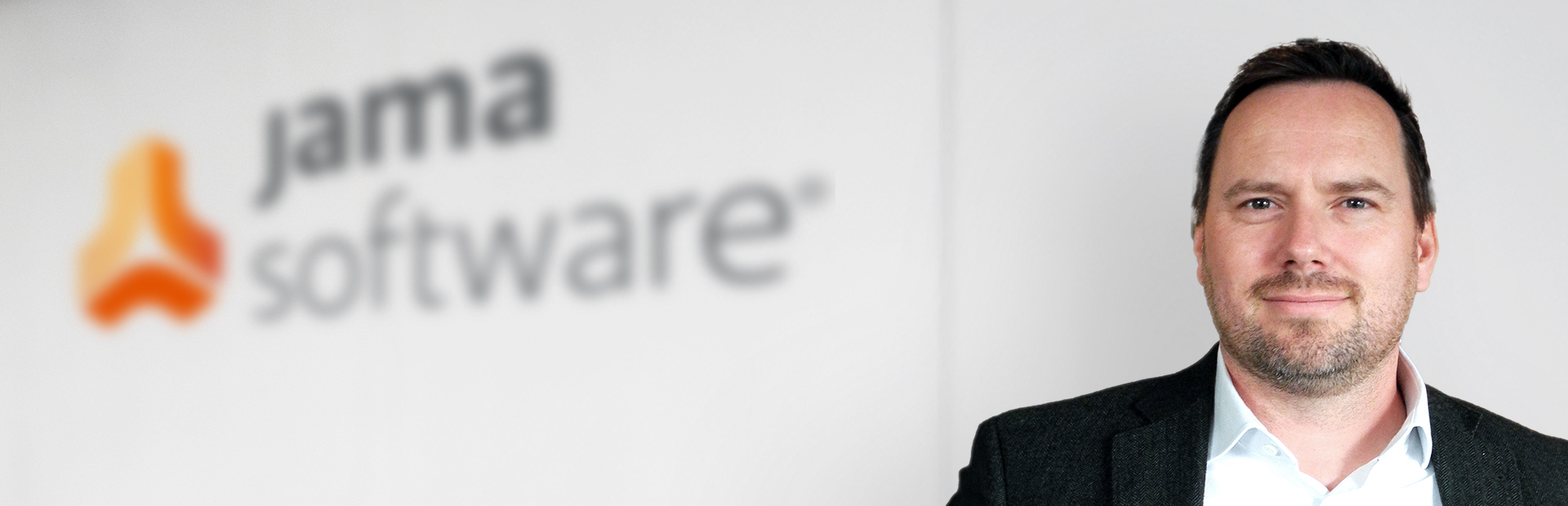
Nick Dudok (born 1984) has been General Manager at ALM vendor Jama Software for the past few months, with global responsibility for the Industrials and Consumer Electronics (ICE) sectors. Prior to joining Jama, he spent 12 years at Lösch & Partner, most recently as Managing Director and Partner. During this time, he supported major ALM transformation projects in the German automotive industry. Following the sale of the boutique consultancy to Capgemini, he spent two years supporting the integration and was responsible for the global consulting company’s ALM and Systems Engineering portfolio. Dudok studied to become a secondary-school teacher and began his career in the ALM field as Project Manager Requirements Management at automotive manufacturer BMW.