

From System Integration to Structured Engineering Knowledge for Reliable AI Agents
Most companies today run a deliberate best-of-breed system landscape in engineering. The challenge lies in the missing connections between the tools – the PLM, ALM, ERP, MES, and CAx systems. Relationships between requirements, components, tests, and manufacturing objects live in engineers' heads, not in the systems. The PROSTEP Digital Thread Platform makes these connections explicit, machine-readable, and traceable. Every synchronization automatically stores typed relationships in the central Knowledge Base. This way, the knowledge base grows automatically, without a separate project.
For more than 30 years, automotive OEMs, aerospace manufacturers, shipbuilders, and medical technology companies have relied on PROSTEP. The PROSTEP Digital Thread Platform combines over 30 production-ready system connectors with a shared relationship graph that grows more valuable with every new integration.
Knowledge Base — The Central Framework of the Digital Thread
A consistent Digital Thread determines whether, for example, a change to a system requirement finds its controlled path through mechanics, software, testing, and manufacturing, or disappears at a system boundary. The PROSTEP Digital Thread Platform makes exactly these connections explicit, without touching the existing system landscape: during every integration process, typed relationships between Configuration Items are captured and stored in the Knowledge Base. In addition, the PROSTEP Digital Thread Platform actively crawls connected systems to surface existing but not yet captured relationships.
The semantic foundation within the PROSTEP Digital Thread Platform is the prostep ivip Top Level Ontology (TLO), which defines universal engineering concepts and lifecycle state. Building on this, the PROSTEP Digital Thread Platform implements the CASCaRA model, the Digital Thread standard we developed jointly with prostep ivip e.V., GfSE e.V., VDA e.V., and PDES Inc. This allows our Knowledge Base to map cross-domain terminology across all connected systems, from the universal level (Entity, Artifact, Version) to the domain-specific level (Requirement, Component, Interface, Test, Change), and build a Product Information Graph.
What the Knowledge Base makes practically possible
Cross-domain impact analyses run in seconds. Configuration states across domains, from As-Designed through As-Built to As-Maintained, can be traced through the graph: which bill of materials was active at delivery? Which software version belonged to which field configuration state? Compliance evidence for ISO 26262, ASPICE, or DO-178C is produced by traversal, not by manual aggregation. And for engineering AI agents, the Knowledge Base is the only reliable data foundation.
Digital Data Packages and the Digital Product Passport
The relationships stored in the Knowledge Base are also the foundation for structured data delivery. Digital Data Packages do not require a separate data collection effort: the cross-domain links between engineering objects from PLM, ALM, ERP, and manufacturing were already built during daily integration work. They exist in the Knowledge Base before a package is needed. The exchange format follows PSI 30 and STEP AP242. For the EU Digital Product Passport, which explicitly requires cross-domain product information on materials, configuration states, and repairability, the PROSTEP Digital Thread Platform is already the structural foundation. No new data processes need to be built.
Proven Products for your Digital Thread Strategy
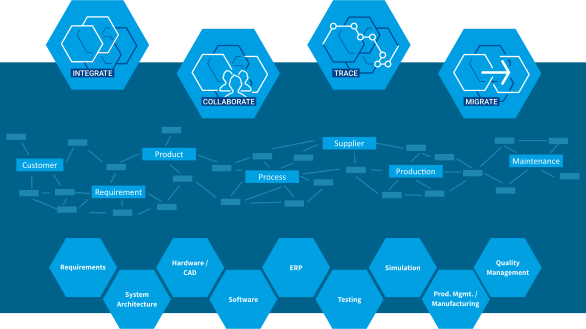
The PROSTEP Digital Thread Platform combines the products OpenPDM, OpenCLM, and OpenDXM into an integrated platform. Each product delivers standalone value while also contributing to the shared relationship graph in the Knowledge Base. The PROSTEP AI-Workbench forms the AI layer built on the Knowledge Base of all products. It is described separately in the next section.

Cross-domain connectivity and synchronization of product information across more than 30 production-ready connectors, with automatic Knowledge Base build-up as a side effect of every integration. Every synchronization captures typed relationships between source and target objects.


Cross-domain lifecycle management: requirements, milestones, and changes are tracked, versioned, and frozen in immutable baselines across system boundaries. The foundation for compliance evidence under ISO 26262, ASPICE, and DO-178C.

Automated, fully logged data exchange with partners and customers, with complete traceability of every transfer, access control, and compliance support for TISAX and ITAR-relevant scenarios.

Incremental or full migration of PLM data, using the same certified connectors as INTEGRATE. Structures, relations, metadata, and CAD integrity are preserved. Migrated data becomes part of the Digital Thread from day one.


Many Small Digital Threads Make One Large Digital Thread
The PROSTEP Digital Thread Platform is designed so that every individual integration delivers immediate standalone value and simultaneously contributes to the growing Knowledge Base.
Every synchronization between two systems stores typed relationships between Configuration Items. When PLM and ALM are connected, the Knowledge Base knows which system requirements are realized by which components. When ERP is added, manufacturing objects are linked to components. No additional mapping effort is required. Every new connection enriches the same graph. The PLM-ALM thread becomes a PLM-ALM-ERP thread. The graph grows not linearly but exponentially, because every new node can be linked to all existing nodes wherever a relationship exists.
The PROSTEP Digital Thread Platform stores more than raw data: it captures the relationships between them. These relationships grow over time into an enterprise-wide Digital Thread that keeps expanding.
Proven system connectors to integrate your complete system landscape
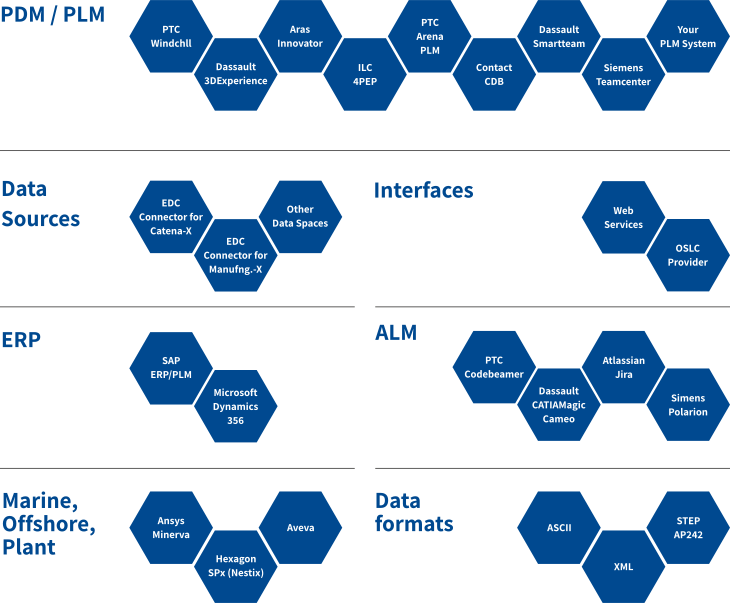
The value of the Knowledge Base grows with every connected system. PROSTEP provides over 30 production-ready connectors to all major engineering systems, from Teamcenter, Windchill, and 3DEXPERIENCE to Jira, Codebeamer, and SAP S/4HANA, as well as domain-specific systems for shipbuilding, plant engineering, and medical technology. The generic REST architecture requires no customizing in source systems.
Visit the PROSTEP System Connectivity page
Deployment Options
The PROSTEP Digital Thread Platform is available on-premises, in a private cloud, and as SaaS. Switching between deployment variants is possible without losing existing configurations. The PROSTEP AI-Workbench is available in all variants and is LLM-agnostic: different commercial language models or locally operated LLMs can be connected. The platform is ISO 27001-certified.
Contact us
Whether you want to connect a first system pair, build your Knowledge Base, or start with engineering AI agents, get in touch. We define a concrete next step together.
