

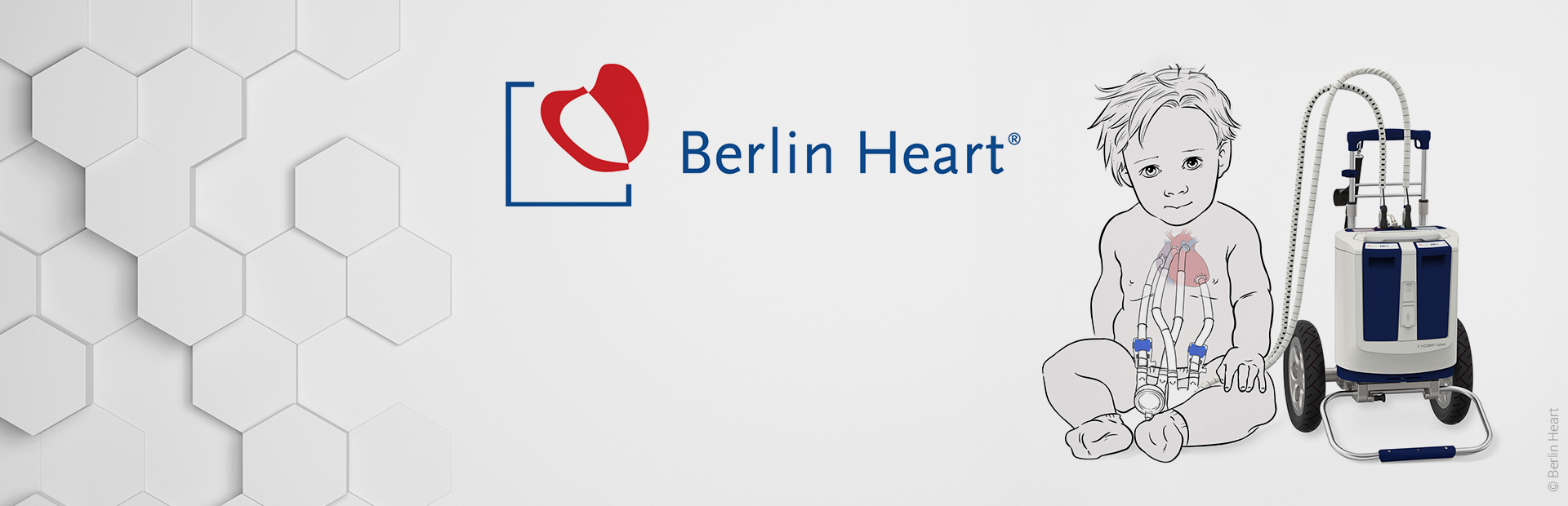

Berlin Heart GmbH, headquartered in Berlin, is one of the few medical technology companies worldwide that develops, manufactures, and distributes ventricular assist devices (VADs) specifically designed for children. These systems are used in cases of severe heart failure, when the patient’s own heart cannot adequately ensure the body’s blood supply, to support patients until a donor heart becomes available. “In rare cases, the heart can even recover during this support,” explains Aaron Rodemerk, R&D Test and Measurement Management at Berlin Heart, one of the project leaders.
Founded in 1996, the company’s flagship product is EXCOR, the paracorporeal heart assist system, consisting of cannulas that are sutured directly to the left and/or right ventricle of the heart and routed through the abdominal wall. Through these, the blood is directed into a pump located outside the body, which returns the blood to the circulation at a frequency of 60 to a maximum of 130 beats per minute. The pumps are available in sizes from ten to 80 milliliters and can therefore serve both newborns and adult patients. They are operated with a portable drive system that Berlin Heart developed in cooperation with its partner Zollner Elektronik AG, where it is also manufactured.
In the past, Berlin Heart and Zollner used IBM DOORS as their shared requirements management software. When Zollner introduced Polarion ALM from Siemens, Berlin Heart faced the question of how to shape collaboration on development projects going forward. “The biggest driver for the migration project, however, was the topic of traceability – that is, the traceability of requirements not only for the approval process but across the entire lifecycle – and the digitalization of test management,” says Rodemerk. “We wanted to digitalize the approval process more thoroughly, at least with regard to design input and approvals.”

Strict Regulatory Requirements
As a manufacturer of life-critical medical technology products, Berlin Heart must meet very strict regulatory requirements. There are numerous national and international standards, as well as risk management specifications and, depending on the target market, varying customer requirements. A central challenge is ensuring that every single requirement remains fully traceable up to its verification. This seamless traceability is a decisive prerequisite for product approval in medical technology and is also indispensable for product maintenance. The stricter requirements of the European Medical Device Regulation (MDR) compel medical technology companies to recertify even products that have already been approved.
For approval, the company must demonstrate that the respective system is intended for specific applications, delivers the performance specified for those applications, and operates safely. A single development project can comprise more than a thousand requirements, which may result in one or more tests. Tracking on paper whether all tests have been carried out can be very time-consuming.
In the past, many processes at Berlin Heart were heavily paper- or document-based. Test cases, for example, were printed out, signed by several people, executed, signed again, and then scanned back in and archived. “The documentation and proof of completeness alone could take months,” says Rodemerk. It was particularly laborious to manually trace the relationships between requirements, tests, and evidence, as well as the impact of changes – whether to standards or product requirements.

Digitalization as a Challenge
“The greatest challenge in digitalization is to transfer our established and well-secured processes into the digital world without compromising quality,” Rodemerk continues. “It must be ensured that all information is fully preserved.” Against this background, Berlin Heart decided to use the services of PROSTEP and its subsidiary BHC for the implementation of Polarion-X, the data migration, and the digitalization of the processes. “We were looking for a competent partner who knows the pitfalls of such projects,” Rodemerk further explains.
The project is being implemented by an interdisciplinary team that includes up to 15 people on the Berlin Heart side from development, the test department, product maintenance, regulatory affairs, and quality management; the core team consists of three people. The kickoff was an on-site discovery workshop in which the project team defined the requirements specification for the introduction of Polarion-X and the integration with Zollner; the actual implementation then took place predominantly online. As part of the workshop, Berlin Heart also discussed possible alternatives with PROSTEP but ultimately chose the Siemens solution in order to ensure reliable data exchange with its development partner.
To avoid the effort of procuring and maintaining its own Polarion installation, Berlin Heart uses the cloud-based SaaS version of Polarion. For the integration with Zollner, Berlin Heart relies on the OpenPDM integration technology of the PROSTEP Digital Thread Platform, which facilitates the connection of additional development partners and internal expert tools. The company uses, for example, the PLM system PTC Windchill in combination with the CAD software Creo for mechanical design, as well as the ERP system proAlpha ERP, which can be connected to Polarion-X via the OpenPDM integration technology.
The experts from PROSTEP and BHC mapped the processes and configured Polarion taking into account the process requirements and regulatory framework, in order to make handling the new ALM solution as intuitive as possible for employees. Through the configuration options and scripts, the processes in the SaaS solution were automated so that information about risk probability only needs to be maintained in one place – in a single source of truth. From there, it can be referenced in all relevant documents and automatically updated when changes occur.
Polarion-X will be the leading system for requirements and test management going forward. The requirements in the form of requirements and functional specifications, as well as the test specifications for verification and validation, were initially migrated on a trial basis in order to test the new application with the digital approval processes. After successful validation of the processes, the remaining legacy data is also to be fully migrated, and the DOORS server will be “frozen” at this state, as Rodemerk explains. Currently, 60 employees from the areas of systems engineering, requirements, risk, and test management are already working productively with the solution on new projects.
In a further project step, the project team will connect the development partners to Polarion-X. In addition to Zollner, this also includes Berlin Heart’s sister company Codialist, which develops the software for the heart assist systems. The plan for connecting Zollner provides for synchronizing test results with Berlin Heart’s Polarion instance and linking them with the test cases and requirements in order to assess which tests have been carried out, whether they are fully fulfilled, and if they meet the quality requirements. Although both partners use the same ALM system, they must map their data models to each other and align their processes – a task that OpenPDM will take over and automate. OpenPDM is also the tool for implementing the rules governing which scope of information is to be shared.

Time Savings through Data-Driven Processes
Although not all use cases have been implemented yet, the first benefits are already becoming apparent. One already noticeable advantage is that Polarion-X, in combination with the transition to data-driven processes, offers the possibility for several people to work on a document at the same time. “That is the normal case for us and promises very significant time savings,” emphasizes Rodemerk. “The test cases for a functional specification can now also be created by several people simultaneously, which was not previously possible.”
According to Rodemerk’s assessment, the execution of tests will also accelerate significantly when they can be digitally prepared, carried out, and documented. Digital approval in particular promises enormous time savings, because you no longer have to wait hours for six people to sign a document. In project management, efficiency gains arise from the fact that the status of tests will in future be automatically traceable in the system and no longer has to be maintained via separate Excel lists. And in the area of product maintenance, the new solution offers the advantage that the effects of changes can be analyzed much more quickly thanks to the linking of requirements, standards, risks, and tests.
In addition, the consistent linking of all data via the Digital Thread opens up new perspectives for the use of artificial intelligence, for example in checking requirements for consistency, clarity, or possible contradictions, as Rodemerk concludes. “We have a very inquisitive team, and the people are enthusiastic about the possibilities that the new solution offers them, as well as about the time savings and the greater convenience.”