

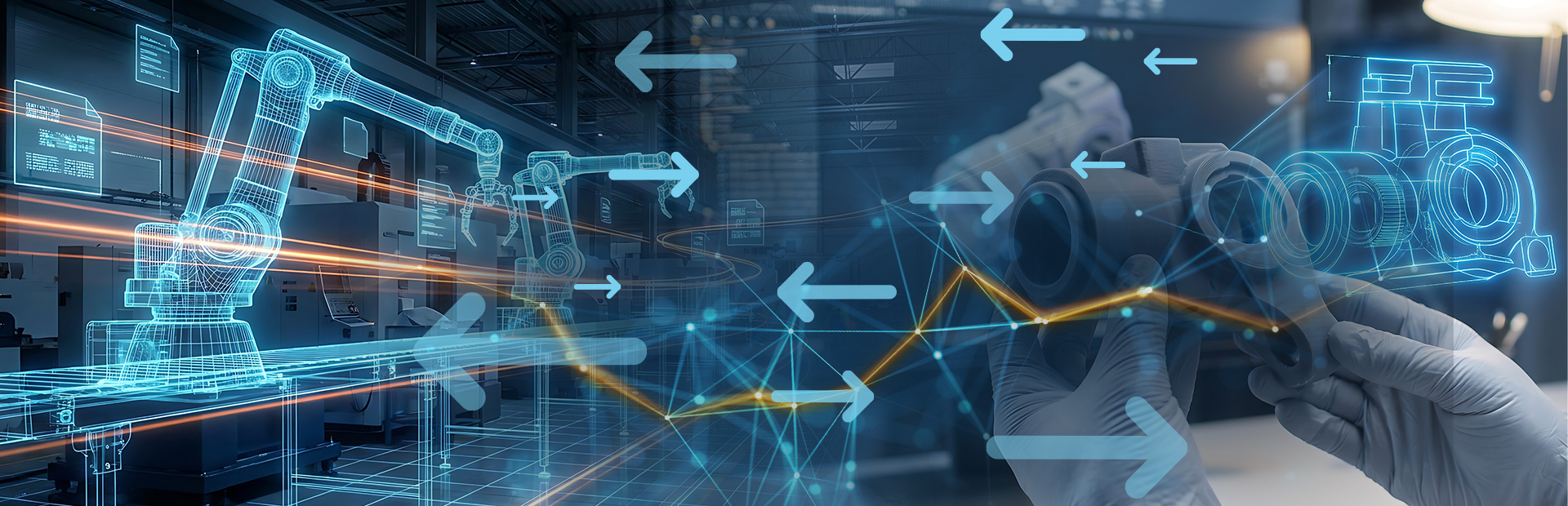

Products are increasingly becoming connected systems in which mechanics, hardware, and software are closely interlinked. Software plays an ever-greater role in this and takes over more critical functions. In addition, these systems are developed in global value creation networks. All of this leads to a new level of complexity in product development. In this environment, traceability, understood as the ability to trace dependencies and decisions across the entire lifecycle, becomes a strategic necessity.
Traditionally, companies saw traceability primarily as a regulatory obligation: requirements had to be linked with functions and tests to comply with regulations and standards. But its effects go far beyond that. Today, traceability is a driver of efficiency and innovation. It creates transparency about the origin of the data, the effects of changes, and the quality of decisions. And it enables insights from the usage phase to be fed back into development.

The first dimension is forward traceability along the value chain. It ensures that requirements can be tracked from the early concept phase through to manufacturing and operation. Every decision, every change, and every artifact must be unambiguously referenceable: from the requirement through the CAD model and the bill of materials all the way to the production order. Only in this way can it be guaranteed that the delivered product corresponds to the original specifications and that changes are implemented in a controlled manner.
The second dimension is backward traceability from the operating phase back into engineering. Connected products today deliver a wealth of data: operating states, load profiles, error codes, service reports. This information is worth its weight in gold if it is used systematically. Backward traceability means linking these data with the original requirements, models, and processes. In this way, companies can analyze the root causes of faults, validate design decisions, and derive improvements. Without this feedback, the digital twin remains incomplete and the opportunity for continuous optimization goes unused.
The requirements placed on traceability are high in this context. It is about the integration of complex information objects: requirements, functions, geometries, simulation results, software versions, manufacturing data, and operating information. These objects must be connected across system boundaries – PLM, ERP, MES, IoT platforms – and their relationships have to remain consistent even when changes occur.
Added to this is the semantic dimension: traceability only works if the meaning of the data is understood. A CAD model is not simply a file but represents a particular version of a component with defined properties. A service report is not only text but contains structured information that refers to specific product instances. Without this semantic clarity, gaps arise that interrupt traceability.

Companies also have to ensure that traceability does not require a large administrative effort. They need automated mechanisms to be able to establish and maintain the relationships between artifacts and processes, especially when changes occur. Manual maintenance involves too much effort as the data volume grows and leads to errors.
Traceability in both directions is therefore not an isolated function, but an integral component of the Digital Thread. It connects development with manufacturing and operation, creates transparency, and enables a genuine closed-loop strategy back into development. Companies that take this capability into account ensure compliance, reduce quality problems, avoid higher costs, and beyond that unlock innovation potential.
The challenges are great, but solvable. The PROSTEP Digital Thread Platform offers the building blocks for end-to-end traceability in both directions. It links requirements, models, processes, and operating data across system boundaries, ensures semantic consistency, and automates the maintenance of relationships. As a result, traceability does not become a burden, but a strategic lever for quality, efficiency, and innovation.